
Use this endpoint to get the list of segments.
API at a glance
Description: This API retrieves a list of segments with filtering and pagination options. Segments are groups of users that meet specific criteria and are used for targeted campaigns.
Authentication & testing
Testing the API on this page
How to try it here
- Use your User API Key as the Username (leave Password blank).
- Select the appropriate API endpoint based on your Blueshift region.
- Enter the necessary parameters and click Try It to run the request.
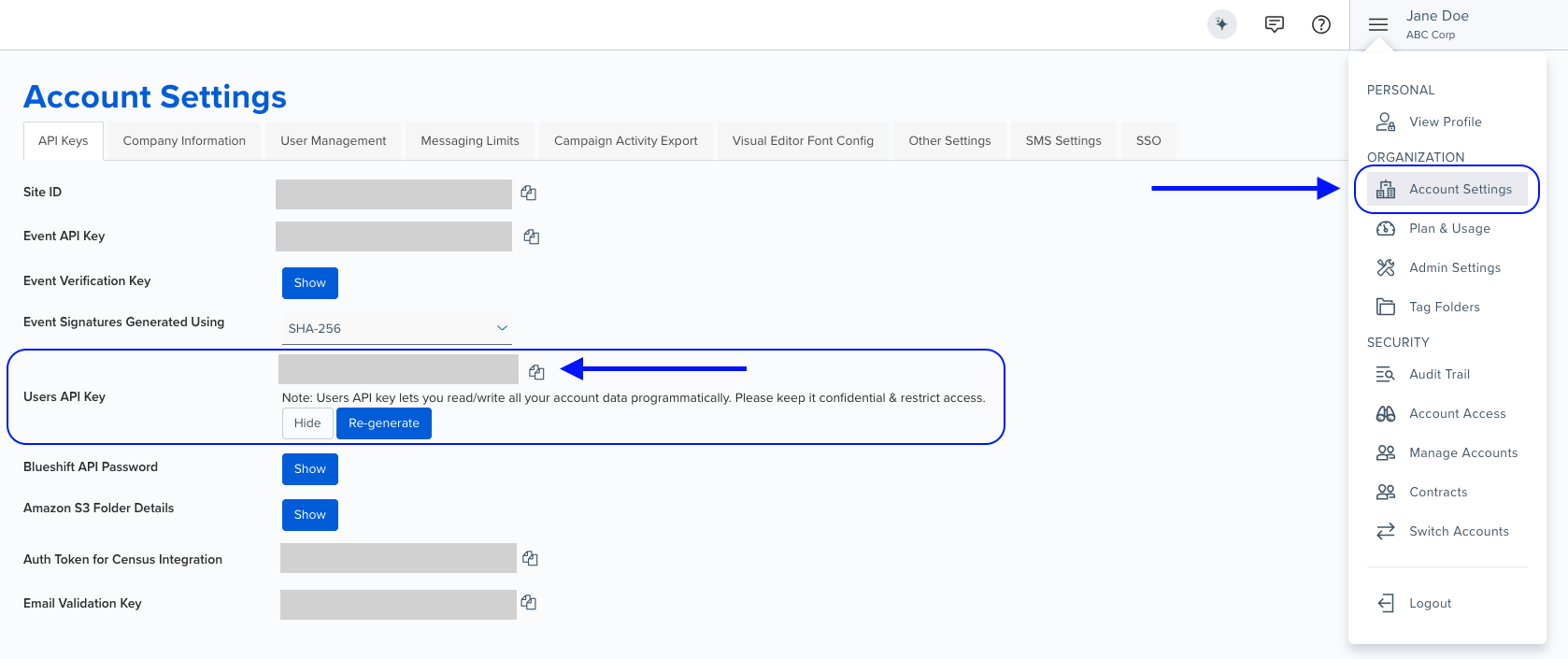
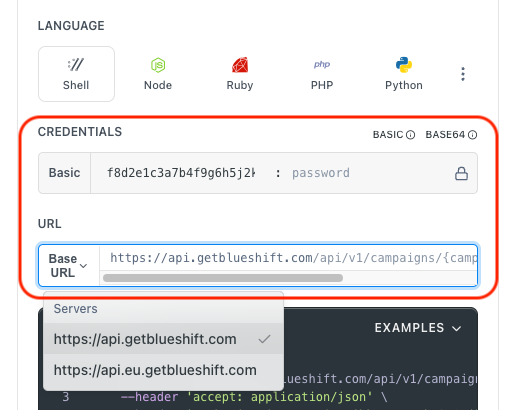
Authentication using Base64 encoding
Note for developers
API requests require authentication using HTTP Basic Authentication with an API key.
The API key serves as the username, while the password field should be left empty.
The format to encode is: your_api_key: (note the trailing colon).
This string must be Base64-encoded and included in the request's Authorization header as follows:
Authorization: Basic encoded_valueYou can generate the encoded value using a trusted Base64 encoder.
Postman collection
Try it with Postman: Explore the API using Blueshift's Postman collection.
Things to know before you start
- Filtering: Filter segments by name (substring match) and archived status.
- Pagination: Use
pageandper_pageparameters to paginate through results. - Archived status:
0for unarchived,1for archived, omit for all segments. - User counts: Response includes approximate counts for total users, emailable users, SMS users, and push-enabled users.
- Use case: Best for listing available segments, auditing segment inventory, and integrating segment data with external systems.
Request parameters
Check out the request parameters
Query parameters
Note: All query parameters are optional.
| Parameter | Type | Required | Description |
|---|---|---|---|
name | string | ❌ No | Search for segments containing this string in the name. |
archived | integer | ❌ No | 0 for unarchived, 1 for archived, omit for all segments. |
per_page | string | ❌ No | Number of records to return per page. |
page | string | ❌ No | Page number for the search results. |
Example requests & responses
Get all segments
GET /api/v1/segments/list{
"segments": [
{
"name": "High value customers",
"uuid": "e24f90d8-53df-46fd-8014-ff1bfa8774b5",
"mixin_key": null,
"created_at": "2024-08-25T06:06:59.412Z",
"updated_at": "2021-08-25T06:06:59.412Z",
"status": "active",
"approxusers": 15000,
"email_users": 12000,
"sms_users": 8000,
"push_users": 5000,
"approxusers_updated_at": 1640995200,
"version": 2
}
]
}Get unarchived segments with name filter
GET /api/v1/segments/list?name=high&archived=0&per_page=10&page=0{
"segments": [
{
"name": "High value customers",
"uuid": "e24f90d8-53df-46fd-8014-ff1bfa8774b5",
"mixin_key": null,
"created_at": "2024-08-25T06:06:59.412Z",
"updated_at": "2021-08-25T06:06:59.412Z",
"status": "active",
"approxusers": 15000,
"email_users": 12000,
"sms_users": 8000,
"push_users": 5000,
"approxusers_updated_at": 1640995200,
"version": 2
}
]
}Bad request - The request was invalid or cannot be otherwise served. An accompanying error message will explain further.
Resource not found - Can happen due to resource conflicts. Re-try with exponential backoff. Contact us on [email protected] if the issue persists.
Conflict error, please retry - The request could not be completed due to a conflict with the current state of the target resource, re-try with exponential backoff.
Rate limit exceeded - Too many requests. Contact us on [email protected] for recommended throughput.
Internal Server Error - Please contact blueshift for more information.
Service unavailable, please retry - Bad Gateway, re-try with exponential backoff.
Service unavailable, please retry - Service Unavailable, re-try with exponential backoff.
Service unavailable, please retry - Gateway Timeout, please re-try with exponential backoff.